Pilih bahasa

In industrial automation,medical diagnostics,and automotive engineering,the Human-Machine Interface(HMI)is the critical bridge between operator intent and mechanical execution.Yet,the physical contact point—the elastomeric button—is frequently treated as a secondary design consideration or a budget-line consumable.When a generic button sticks,cracks,or loses its tactile feedback,the operator fundamentSemuay loses control of the system.This single point of failure can render a multi-million-dollar machine inoperable,creating hazardous operational conditions and driving up the Total Cost of Ownership(TCO)through unplanned control board replacements and costly downtime.
At Guangdong Sunlite Science&Technology Co.,Ltd.,we apply a"SmSemua PRODUK,Big Impact"philosophy to every elastomeric component we engineer.We understand that an industrial button is not just a piece of molded rubber;it is a precision actuator.By leveraging high-performance silicone formulations,our engineers deliver tactile Solusi designed for absolute reliability,precise feedback,and longevity in the most unforgiving environments.

Technical Breakdown:The Engineering Superiority of High-Performance Silicone Buttons
The functional life of an elastomeric button directly dictates the functional life of the device interface.Standard commercial rubber or rigid thermoplastics rapidly degrade under mechanical fatigue,UV exposure,and thermal cycling.Furthermore,standard inks used for interface labeling often delaminate,and inconsistent material density leads to poor tactile feedback and erratic electrical contact.
Sunlite's precision silicone buttons are engineered to eliminate these exact failure modes.Utilizing advanced closed-loop mixing and precision compression molding,our silicone elastomers achieve a highly stable molecular cross-linking density.This ensures the material retains its exact Young's Modulus and actuation force across an incredible lifespan of≥500,000 cycles.
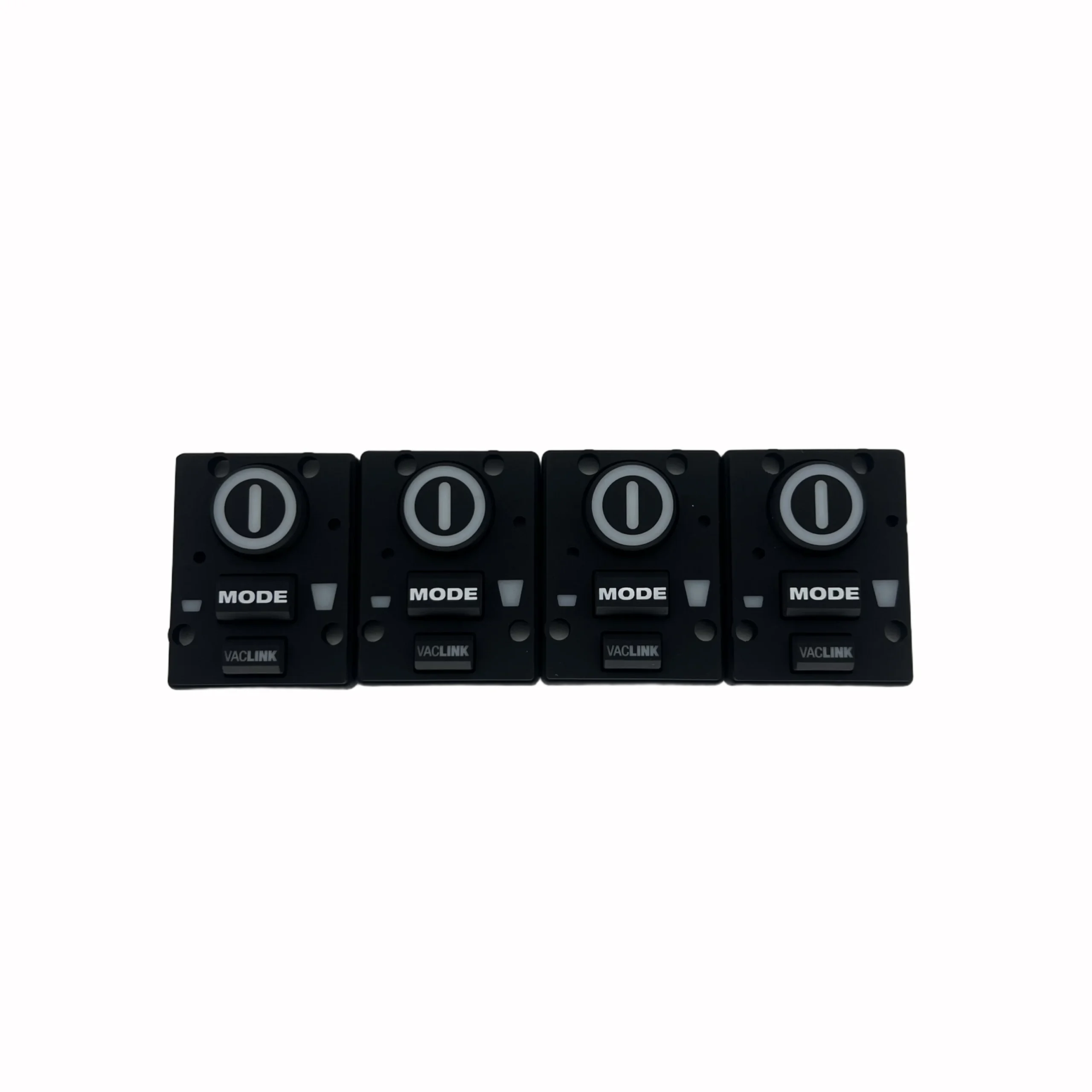
For illuminated interfaces,Sunlite engineers build in precise light transmission and blocking Kemampuan.By co-molding clear silicone light guides with opaque blocking layers,we Sebelumnyaent internal light bleed,ensuring high-contrast visual feedback without phantom illumination.Furthermore,our proprietary surface treatments guarantee non-peeling silk screen printing,maintaining crisp legibility even under aggressive industrial abrasion.
Sunlite Precision Silicone Button vs.Standard Interface Materials
Engineering Specification | Sunlite Precision Silicone Button | Standard Thermoplastic/Basic Rubber | Impact on HMI&System Performance |
Actuation Lifespan | ≥500,000 Cycles | <100,000 Cycles | Eliminates premature switch failure and expensive board replacements |
Temperature Stability | -50°C to 250°C | -10°C to 70°C | Sebelumnyaents button cracking,stiffening,or sticking in extreme environments |
Optical Properties | Precise Light Transmission&Blocking | Uneven light bleed/No integrated light guide | Ensures clear interface visibility without hazardous light pollution |
Surface Wear Resistance | Non-Peeling Silk Screen Printing | Quick fading/Ink delamination | Maintains legible control panels over years of heavy daily operation |
Chemical&Bio-Compatibility | Medical/Food Grade,High Resistance | Reactive/Prone to chemical swell | Sebelumnyaents contamination and material degradation in harsh washdowns |
Real-World Aplikasis:WDi Sini Precision Silicone Buttons Sebelumnyaent System Failure
An engineered silicone button does far more than close an electrical circuit;it seals the sensitive internal enclosure,provides critical ergonomic feedback to the operator,and withstands environmental extremes that destroy standard plastics.

1.Medical Diagnostics and Surgical Devices
Medical hardware must operate flawlessly while enduring rigorous,highly corrosive chemical sterilization protocols.Standard elastomers swell,crack,or degrade when repeatedly exposed to hospital-grade disinfectants and autoclaving temperatures.Sunlite utilizes bio-compatible,high-grade silicone that resists severe chemical washdowns and extreme thermal fluctuations.With a guaranteed lifecycle exceeding 500,000 actuations,these keypads ensure that life-critical surgical interfaces and diagnostic controllers remain highly responsive and compleTely sterile throughout the hardware's operational lifespan.
2.Heavy Industrial Control Panels and CNC HMI
Heavy-duty manufacturing environments subject control interfaces to continuous mechanical abuse,abrasive dust ingress,and exposure to cutting fluids and machine oils.When a control button on a CNC machine or heavy stamping press sticks due to material swelling or structural fatigue,it creates an immediate,catastrophic safety hazard.Sunlite's ruggedized silicone keypads provide an impenetrable seal against environmental contaminants,helping devices meet strict IP67/IP68 waterproof and dustproof standards.The non-peeling silk screen printing guarantees that critical control functions—such as the Emergency Stop—remain highly visible and tactile despite years of friction from heavy industrial work gloves.
3.Automotive and Aerospace Electronics
Vehicle cabins and aircraft flight decks experience severe temperature swings,ranging from-50°C at high altitudes to over 100°C under direct,prolonged solar load.Basic thermoplastics warp and lose their tactile"snap"under these extreme thermal conditions.Sunlite’s silicone formulations maintain a consistent,engineered actuation force curve regardless of the ambient temperature.MENAMBAHKANitionSemuay,our precise light transmission and blocking technology is vital for these transport sectors,ensuring backlit dashboard buttons and overhead panels are perfectly uniform for night-time operation without distracting light bleeding into the dark cabin.
Sering ditSetiapakan PertSetiapaan(FAQ)
Why is silicone the preferred material for industrial buttons and keypads?
Silicone offers an exceptionSemuay wide operating temperature range(-50°C to 250°C)and superior compression set resistance.Unlike standard rubber,its molecular structure does not lose elasticity or harden over time,ensuring a consistent tactile feel and reliable electrical actuation for over 500,000 cycles without mechanical degradation.
How do you Sebelumnyaent the symbols on a rubber button from fading or peeling?
At Sunlite,we Sebelumnyaent surface wear by utilizing specialized silicone-based inks combined with a high-temperature vulcanization process.This ensures the non-peeling silk screen printing chemicSemuay bonds directly with the button's silicone substrate,making the graphics highly resistant to friction,operator sweat,and harsh industrial cleaning agents.
What is precise light transmission and blocking in keypad design?
For backlit keyboards,light bleed between adjacent keys can confuse operators and severely degrade the interface's appearance.We use specialized dual-molding techniques and opaque silicone base layers to block unwanted light,channeling LED illumination only through specific transparent light guides for sharp,high-contrast visual feedback.
Secure Your HMI with Guangdong Sunlite Science&Technology Co.,Ltd.
Do not Semuaow a failing tactile interface to compromise the reliability of your advanced hardware.Upgrading your HMI components to precision-engineered silicone is the most effective strategy to guarantee operator safety,extend device longevity,and optimize your Total Cost of Ownership.
At Guangdong Sunlite Science&Technology Co.,Ltd.,we do more than manufacture rubber parts;we engineer structural and tactile Solusi.Our advanced elastomer Produk strictly comply with global environmental regulations,including RoHS 2.0,REACH,PAHs,POPs,TSCA,and PFAS standards.Contact our engineering team today for custom material formulation,precise actuation force curve design,or to request physical prototypes for your Berikutnya-generation control interface.
In industrial automation,medical diagnostics,and automotive engineering,the Human-Machine Interface(HMI)is the critical bridge between operator intent and mechanical execution.Yet,the physical contact point—the elastomeric button—is frequently treated as a secondary design consideration or a budget-line consumable.